So I've finally reached a point at which I want to continue this film blog. I tried to keep things running over the summer, but my efforts were in vain. However, I'm in college now. I have time on my hands. Well, no, that isn't true. I don't hardly have any time. I just don't want to spend it doing the things I need to do.
The only snag I now run into is that I'm in college. This means that I have very limited monetary funds (even with a job) and even more limited transportation. I have not (after two and a half months of living in Hawaii) been out to a movie theater. Not even the dollar theater. Tragedy.
So I guess I'll just do what I can with what I have. Which is not much.
Revenge movie marathon this Saturday. It's should be good.
Tuesday, November 4, 2008

Sunday, July 13, 2008
(gasp) so (choke cough) behind (hack death death)...
 General Thoughts: It was entertaining. Funny. Worth my $5. But in no way a masterpiece and I don't have a burning desire to see it again. I was impressed at how much I actually laughed during the film. Steve Carell was, as always, absolutely hysterical. There were a lot of moments during the movie where I really saw the presence of Michael (from The Office) in the character of Maxwell Smart. As a side note, look at season one of The Office compared to later seasons. Carell has super creepy hair in season one, but it gets fixed by season two. It probably freaked out one too many. Back to the film. At moments, I found myself skeptically thinking "Really?" where a scene went on far too long (and stopped being funny). Overall, however, it was a relatively enjoyable experience. Ooh, something I need to add. I generally DESPISE Anne Hathaway. I've found that the majority of the films in which she stars were once really good books that have been absolutely mutilated to fit a film format. I didn't hate her here. Impressive.
Favorite Character: The Chief. Love Alan Arkin. Love.
Favorite Line: "Oh look, a box of kittens, I think I'll punch Max." - Maxwell Smart
Favorite Moment: The fact that there is no piano in Beehtoven's Ninth Symphony. Yikes. Big mistake, people. That was kind of a crucial plot detail.

General Thoughts: SCORE! A very solid superhero movie indeed. I was pleased overall. Tony Stark - what a dick. Which makes it even more fun that he became such a rockin superhero. My only problem with his progression from asshole to Iron Man was after he escaped from captivity and was all inspired. The things he was saying were meaningful, but it just didn't seem entirely sincere. Also, I was iffy about the villain (anybody who knows me will know how important villains are to me). Obadiah - pretty solid as a villain. Although there wasn't much buildup to his villainy. It was fairly sudden. I was, however, kind of disappointed in Raza. To me, it just seemed like the typical middle-east setup. I don't know how closely it correlates to the real story from the Iron Man comics, but it seemed like old news to me.
Favorite Character: Pepper Potts (played by Gwenyth Paltrow) - I really like the actress and her character gave Tony Stark a bit of humanity. Plus she totally saved the day.
Favorite Line: "Good God! You're a woman!" - Tony Stark
Favorite Moment: Jarvis the robot-ish continually getting Stark with the fire extinguisher.
Friday, June 27, 2008
So right now I'm working on catching up with all the movies I haven't seen. I haven't gotten very far. However, I am not dissuaded. It'll just take me a little time, that's all. Thus far:
 I was very much impressed by this movie. I had no idea what to expect going into it - I had read the review in the Star Trib (which had nothing but good things to say), desired to see the film, and then promptly forgot about it for a few weeks. Until Father's Day rolled around and we needed a family movie. This is not a family movie. I think my mother is slightly scarred from seeing this film. I adored it. My dad also enjoyed it, but definitely exaggerated his delight upon seeing how much praise I had for the film. Whatever.
Anyway, let me begin by saying I'm not much of a Colin Farrell fan. His roles just never quite did it for me. Here, I was blown away. Farrell was the perfect choice for the totally neurotic, cynical, spazzy Ray. Brendan Gleeson's character Ken was the ideal counterweight for crabby Ray. Round, cuddly-looking, friendly and pleasant. You wouldn't peg either of them as assassins. I don't want to say too much about the plot and I know already that this is a totally crap review, but as the film continued, I was more and more impressed by how deeply into the human psyche director Martin McDonagh was willing to delve. Battles between right and wrong, ethics versus selfishness, and l
ife and death are waged freely throughout the film. Topped off with a beautiful beautiful ending that left me nearly speechless, this film was one that won't leave my mind for quite some time.
Favorite Character: Chloe - played by Clemence Poesy (from Harry Potter 4)
Favorite Line: "Well, here we are in a room with two manky hookers and a racist dwarf." -Ken
Favorite Moment: Ray karate chops Jimmy the midget in the neck. Classy.
 Another pleasant surprise. Although I was told many a time before seeing this movie that it was absolutely hysterical, I still had my doubts. Luckily, I was not disappointed in any way. The plot itself is fairly basic. Fatass panda accidentally/on purpose becomes the savior-to-be for a good chunk of China. Problem: he's a fatass and has no clue what he's doing. Other problem: his dad wants him to go into the noodle business. Other other problem: the bad guy is friggin diesel as hell. And pissed. In short, Po the panda (Jack Black, hilarious as always) figures things out and saves everybody, uttering "skadoosh" simultaneously. Go figure. What really impressed me was how the film catered to such a large demographic. Kids, teens, adults, grandparents. I saw them all there and they were along side me, laughing their asses off at every twist and turn of the film. That is the mark of a good cartoon film. A universal audience. Cheers Mark Osborne and John Stevenson.
Favorite Character: Shifu - voiced by Dustin Hoffman, no idea what kind of animal he was.
Favorite Line: "One often meets his destiny on the road he takes to avoid it." -Oogway
Favorite Moment: Tai Lung zapping Po and Po saying "I'm going to pee" and rolling around laughing. Backfire.
Thursday, June 12, 2008
Nothing relating in any way to film.
I actually just needed a place to put Jonathon's lyrics so I wouldn't forget/lose them.
Track 1:
I'm afraid of injury, cause this hill's too steep and I'm going down fast
Cat scratch, won't last, guess I never had a chance
Living in a world where everybody's getting something somewhere.
You're telling me I gotta be a little more aggressive
When I'm passive in my nature
And I could never be anything else with you.
I don't know why I'm not singing other women songs
I know you're with another but we really seem to get along together.
Track 2:
Once I knew a man who carved angels out of stone
He was paid for his creations but it chills me to the bone
Drank it all away, put his family on the line
His hands work for the lord but his liver works for wine.
Grandfather and daddy, where did you go wrong?
Grandfather and daddy, I hope I don't end up just like this song.
Once I knew a man whose heart was broke when he was two
His poppa died and this guy didn't know just what to do
His mother left him in a bar with her alcoholic friends
From the day she left him, ____ he'd never feel again.
Grandfather and daddy, where did you go wrong?
Grandfather and daddy, I hope I don't end up just like this song.
Track 3:
ask Jonathon.
Track 4:
I live in a state of preventative arrest, political distress
The emperor's undressed but no one wants to tell him so.
A woman on the street asked if I'd offer her a ride, if I wanted a good time
I didn't have a dime to spare so I kept moving on
The men are in the deserts and the ships are out to sea, the prisons have no key
It's hard to see but I think this life will be the death of me
Oh good god on high have mercy on my soul
Oh good god on high have mercy on my soul, on my soul
I try my best to breathe but it gets harder every day, I'm out of things to say
There's not a lot of money left and no place left to stay
It's raining all the time, seems I've never seen the sun
I'm not foolin' anyone
I'm going nowhere fast and where I am's where I've begun
Track 5:
I always offer to pick you up and give you a ride
You always say you're not going my way anymore
And I don't know how I'll get out of this town with my life
Three rounds left to go I don't know if I'm up to a fight.
You told me that lately you were thinking of taking your life
When I asked where you rolled over and went back to sleep
And then I could tell it had all gone to hell a while back
Try as we may seems that we just can't pick up the slack.
Well you don't keep secrets you never look back
You're never afraid to be bold
It kills me to think that there's no chance in hell
So I throw my cards in now and fold.
And cigarettes stink through the vents in my bathroom at five
God it's too early and I'm no more awake than alive.
And I don't know why but I can't get you off of my mind
I guess it's just women like you are the hardest to find.
You don't keep secrets you never look back
You're never afraid to be bold
It kills me to think that there's no chance in hell
So I throw my cards in now and fold.
I might as well tell you these things that I feel for you're gone (?)
Any excuse just to write you another damn song.
Track 6:
I'm on my own with the pain in my head
I either wish you were here or I wish I were dead.
These pills work just fine but give me pretty strange dreams
Seems I'm losing my mind but things are worse than they seem.
I'll take you to the bottle and you can stay with me awhile where there's no morning
I'll take you by the hand and show you rings in hell you never seen before
The man in the box (?) said things are gonna change
But the hole in my heart always seems to stay the same.
I heard you're bleeding again, I'm glad to know I'm not alone
If you need a bandage, babe, you know I'm always home.
I'll take you to the bottle and you can stay with me awhile where there's no morning
I'll take you by the hand and show you rings in hell you never seen before
I'm on my own with the pain in my head
I either wish you were here or I wish I were dead.
Track 7:
ask Jonathon.
Track 8:
(radio intro)
Highways got nothing on the side streets where everybody moves a little slower
Small town, big hearts, white picket fence, nobody locks their doors
And real life's got nothin on the movies where everything works out fine
Everybody's beautiful in those picture perfect endings, everybody drinks expensive wine.
But these pills got nothing on the oxygen, flows through my blood to my brain
Living life from both sides now and nothing feels the same.
[break, new melody thing]
I got time and time's got me, I still gotta make a lot of history
And travel round the world and the seven seas, I'll die too soon and I'll cease to be.
I'm gonna cease to be (x4)
Gonna start a war gonna catch a disease, I'll hang around your ____ with ____ Japanese
I'll wear a pair of socks that goes up to my knees, I'll die too soon and I'll cease to be.
I'm gonna cease to be (x4)
Track 9:
ask Jonathon.
Monday, May 5, 2008
Villainy, Harcore.
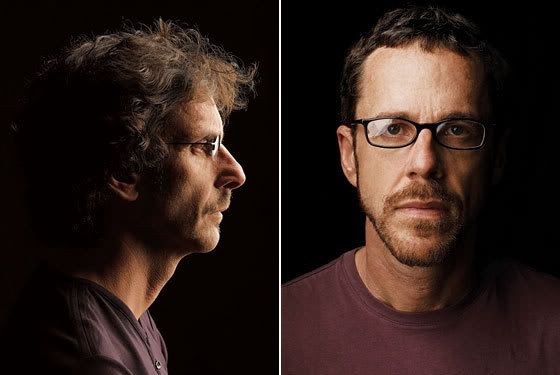
Ahh, villains. Villains are generally my favorite part of any given film. And, of course, I have to give the Coen brothers some serious props for their excellent movie villains. They are cunning, devious, and pure evil. If I were an evil villain (a status I hope to achieve someday), I would be honored to have a part in a Coen Brothers film because it would be a testimony to the level of my absolute evil-ness. And my bad-assness. And my harcore-osity. Which would be excellent. Anyways, not a single villain in any of the Coens' movies is disappointing. We have good old Leonard Smalls, terrifying on sight. Between the beard, the super badass Harley, the disgustingly flattened nose, the extreme ammunition, and the tendency to shoot small defenseless animals, he is a force to be reckoned with. My only problem with Smalls was his voice. Yikes. Super nasal, super unintimidating. Luckily his appearance (especially the baby booties attached to his belt) made up for it. Almost. Moving on to Carl and Gaear. Carl, while an excellent villain, kind of sucked at life. It didn't help that he looked absolutely ridiculous. Especially after he got shot in the face. Gaear, on the other hand, was the epitome of the pure evil villain. Hardly speaking, his very presence has the power to strike fear and discomfort into the minds of the audience. As his body count continues to grow, Gaear really fleshes out exactly what it means to be a villain. If only he had a little pointy moustache to twirl. Although that might have ruined it. I can't really imaging the wood chipper scene with a moustache. Ah well. Finally, we have good old Anton Chigurh. Again, pure evil. Fairly sociopathic. Kind of a beast, and as such intimidating. Not somebody you want to mess with. Or even see. Because he'll kill you. Wow. Anyway, once again we have a villainous killing machine. Chigurh feels no remorse for any death he has caused right up until the end of the film. Killing Carla Jean definitely throws him off a little bit, but in no way does that demean his level of villainy. If I was a super duper evil villain, I would love to be his protege. If he didn't kill me first.
Friday, April 18, 2008
A Jaunty Hat Indeed.

Ahhh Altman. Such a breath of fresh air after the Kurosawa unit. Until, that is, we reached Nashville. Let's just not talk about that. And so, cinematic highlights of the two more bearable movies in this trio....and here we go.
The Long Goodbye: While some people were seriously bothered by the ever-moving camera, it was something I greatly enjoyed. It really gave the viewer the sense that they weren't supposed to be seeing what was going on. Instead of being blatantly part of the scene, the camera skirted around the edges, eavesdropping as much as it could get. Altman uses this same technique in Gosford Park (2001) to achieve possibly even a greater affect. Because that film juxtaposes the lives of the rich and their servants (who are never too be seen except when they're needed), the camera work does a fabulous job of putting the viewer in the place of a valet or maid - always flitting around the outer perimeter of conversations and gatherings. Back to The Long Goodbye, I also really enjoyed Marlowe's character. It was almost refreshing to have someone who seems to have been asleep for a few decades. His mannerisms and even his clothing helped to shape the movie and its plot.
The Player: Again we see some excellent camera work in this film. Even in looking at the opening sequence of the movie, it is an enormously long shot, lasting probably six or seven minutes. The moving camera fits well with the plot line because of the apparent chaos of Hollywood life. As people interact and criss-cross across the scene, the camera follows those people who matter, often switching directions mid-track or abandoning a person entirely. I also liked the eerie darkness of this film. It deals with murder as does The Long Goodbye and Nashville, but in a very different light. Here, the protagonist is the one who murdered in cold blood. Instead of hating him for what he does, the viewer doesn't feel those emotions. It still feels natural to stick up for him and hope that he doesn't get caught. Upon thinking about the film after viewing it, the realization that you have been rooting for the bad guy is slightly disconcerting. The magic of film making.
Tuesday, March 18, 2008
I wish I could come up with a catchy title, but it just isn't going to happen.

Akira Kurosawa. I'm kind of undecided on how I feel about his films. In some aspects, I really enjoyed the Kurosawa films we watched in class. In others, I really didn't.
Take Stray Dog for example. To begin with, the entire movie gets an incredibly uncomfortable vibe because of how sweaty everyone is. When people are sweating so profusely that they are literally drenched, it's just kind of icky. Count me out. The character of Murakami also bothered me throughout most of the movie. His obsession over what happened to the gun was understandable, but it got too extreme. He took everything as a personal attack and whenever something awful happened with his gun, he tried to take full responsibility. Generally, this would be an admirable quality. However, it was just overdone and became really obnoxious instead of respectable. My final problem with the film was the slow progression of the story. It wasn't easy to follow in the first place and when the plot is only creeping by, it doesn't help the situation. When a slow plot is added with something like the montage sequence of Murakami exploring the black market, the film is nearly too unbearable to watch. Definitely not my favorite.
Yojimbo and Ran were far more enjoyable for me to watch. There was more to the stories, characters I liked better, and more action than a couple of cops wandering the city. These films didn't try my patience hardly at all (a very nice break after Stray Dog) and I was able to follow and enjoy them. Overall, Kurosawa isn't exactly my favorite director, but I'm not going to try to say that he wasn't any good. I'm just really looking forward to starting our Altman unit now.
Monday, March 3, 2008
"Virgil, you weiner."

Ed Harris. What a stud. Way to save the world from nuclear war with a bizarre water-controlling alien species by being willing to sacrifice your life to disarm a nuclear warhead that some psychotic asshole of a Navy SEAL sent into the depths of the abyss. A gold star to you, my good sir.
Anyway, The Abyss was an interesting movie. I know that the word interesting doesn't necessarily denote something good, but I think it does in this case. Clearly I haven't quite made up my mind yet. In no way did I enjoy The Abyss as much as The Terminator, but it was still two hours and forty-five minutes of my life that were relatively well-spent. I was definitely surprised at how normal most of the movie was (normal being the operative word).
The Abyss tells the story of a pretty random group of people who work on an oil rig in the ocean. When a US submarine gets struck down by some unknown party (most people think it's "the Reds"), they get sent to rescue any survivors and check stuff out in general. The rig workers even get the help of some Navy SEALS (all except one end up dead or being total jerks). For most of the movie, they're legitimately trying to do what they're supposed to do without falling into the abyss and never seeing the light of day again. Obviously, they encounter some problems with this, but whatever. It's to be expected. I'm going to make a suggestion now. If you plan on ever seeing this movie, don't read on (even though I kind of already ruined part of it in the first paragraph). Heed this warning or pay the consequences.
I was totally surprised with how normal the movie was until maybe the last hour. It went from a moderately realistic plot line to one riddled with aliens. Ouch. However, considering that I was dealing with James Cameron, I was willing to put up with the large fluorescent amoebic monster/alien/machines to see where it all went. And go it did. To cut the introduction short, Ed Harris frolics (sinks) his way more than three miles down into the abyss to disarm a nuclear warhead. After he arrives and accomplishes his mission, he doesn't have enough air to get to the surface. Ed Harris (self-sacrificing and valiant as ever) accepts this doomed fate extremely calmly and sits back to enjoy the eerie and oddly-present iridescent lighting in the deep evil abyss. He prepares himself for death. BUT NO! Suddenly, a neon floaty alien comes to his rescue, takes him by the hand, and shows him their marvelous underwater city of alien/monster/machines. Once safely inside, they manipulate the water enough to give him some air to breathe so he doesn't actually die. To cut to the chase, up on land the aliens are threatening the entire world with a mile-high tsunami wave that promises to wipe out the entire population. Meanwhile, Ed Harris is underground and the aliens are explaining, through the magic of television, why they're doing what they are. Of course, they don't actually carry out the nefarious (but well-deserved) scheme because of Ed Harris's selflessness and honor. Go figure. Finally, they somehow float their entire city up to the surface of the water, rescuing the oil rig and freaking out everybody topside. Wow.
That's pretty much the movie right there. I apologize for the large amount of plot summary, but there really was no better way for me to explain myself. And before I forget, may I please talk about my absolute favorite part of the movie. Prepare yourself.
So...Ed Harris and his wife are stuck in a mini-submarine that is quickly filling up with water. They have one dive suit between them (Ed has it). If they don't do something soon, they're both going to die. They quickly decide that Ed should drag his wife's body through the frigid ocean back to the oil rig where (hopefully) they can revive her. Of course, things don't seem to go as planned. I should probably interject the fact that, at this point of the movie, my mom had come downstairs and was watching with me. I should probably also say that, earlier in the day, we had gone to a reception for a university in Hawaii that I might attend to be a marine biologist. Keep that in mind. In the movie, we have Ed Harris desperately trying to revive his dead frozen wife. He tries futilely to use the defibrillator, CPR, he even resorts to slapping her across the face and yelling "Goddammit, you bitch!...Fight! Fiiiiiiiiiiiiiight!" At this point, they show the aforementioned dead frozen wife, very blue in the face and very clearly dead (unfortately, she later came back to life). Then my mother turns to me and says "Oh, Katie, that could be you!" Thanks, mom. Much love.
Overall, The Abyss was not my favorite James Cameron film. However, I still enjoyed it greatly and am still willing to adventure further into Cameron films (although I may avoid Piranha Part II: The Spawning). I haven't decided whether or not this makes me a terrible person.
"I'm fairly alarmed here."

Jurassic Park...what a classic. It is an absolute visual delight that tells a lovely story of the imminent disasters caused by trying to control nature. There are also enormous dinosaurs that eat people.
This past Saturday, Whitney and I saw Jurassic Park at the Uptown theater at midnight. At first, I was iffy about the idea. However, considering the fact that (for once) I didn't have choir the next morning, I decided to go for it. I am so happy I made that decision. Overall, this was an excellent experience. The night started at the Uptown Diner where we indulged in some tasty malts and were slightly creeped out by our enthusiastic waiter. Definitely a positive start. After that, we made our way to the Uptown theater where, after standing in line for a bit, buying our tickets, getting popcorn, and me freaking about about a poster for Teeth, we made our way to the second row and settled in for the long haul.
What a good choice. No viewing of Jurassic Park could ever compare to that with a live audience. Especially if you consider the type of people who would actually go see Jurassic Park at midnight in Uptown. There was no doubt in my mind that the crowd would be excellent and I was not disappointed. At the introduction of each new character, there was much cheering and ruckus. When Wayne Knight was introduced as Dennis Nedry, a distinctly hateful murmur of "Newman..." arose from the audience. Although I was probably the person who laughed when B.D. Wong (who now is on Law and Order SVU) showed up, I didn't feel stupid at all. Fabulous.
I really wish that every movie-going experience could be as lovely and enjoyable as seeing Jurassic Park at midnight. Unfortunately, such is not the case....
Sunday, March 2, 2008
"Television has brought murder back into the home - where it belongs."

A gold star to anybody who can answer the question of the day: what exactly did Hitchcock have against relationships? I don't really understand how somebody who seems to be rather jolly in a dark and suspenseful way can be so clearly bitter about something. Shall we examine the films we viewed in class.
We begin with The 39 Steps. This doesn't exactly support the idea of marriage. As we've discussed time and time again in class, almost none of the relationships in this film are happy. We have the crofter and his wife. He's an angry, religious little Scot and she's just there to make his food and clean the house. Why they're together in the first place nobody knows (clearly they would both be better off with someone else). During the film, Hitchcock exploits their bogus relationship to critique (in a way) the lies about marriage. Even at the end of the film, Hannay and his new found secret love aren't really happy, they're just kind of there. After experiencing such a ridiculous event, happy isn't really an option. It isn't all fun and games, kids. In real life, people are crabby and mean.
Moving on to Rear Window. Again, we've absolutely talked this to death but I'm content with digging the grave a little deeper. Jeff is completely set against marrying Lisa even though she is clearly perfect (and way too good for him as Stella points out repeatedly). Once again, Hitchcock has his protagonist shy away from the idea of marriage. Also, none of the relationships in the apartment complex are happy ones. Ms. Lonely Hearts is suicidal, Ms. Torso entertains man after man because she's bored, the composer sits alone banging away at the piano, Thorwald kills his wife, and the bizarre couple who sleep on the balcony are just bizarre. The only happy couple is the newlywed kids (and that is only because they're having sex like rabbits). Again, this entire movie is a sort of critique on people's awful relationships.
Finally, we have Vertigo. Definitely the most eerie of the films that we watched in class. We have the protagonist of the story in a relationship with a seemingly wonderful woman that he doesn't appreciate (could Hitchcock possibly be bitter about something?) We also have a clearly unhappy marriage, seeing as Elster hatches an ultra-elaborate plot to murder his adoring wife. At this point, we realize that Hitchcock clearly has had some bad relationship experiences. Not to mention an almost sick obsession, something that comes through clearly in this film. Nobody ever gets to be very happy in Hitchcock films.
Honestly, I don't know what Hitchcock could possibly have against relationships. They're not that bad - often they're actually enjoyable. It's possible that he had some bad experiences, maybe he had his heart broken one too many times. But it seems as though he is extremely bitter about this whole "love" thing. Maybe he's just a very crabby person.
Sunday, February 24, 2008
"That son of a bitch took my pants."

The Terminator. What an excellent movie. And believe it or not, I say that without a hint of sarcasm in my voice. Before viewing The Terminator for Art of Film, I had never seen the movie (or any of the sequels). I was familiar with a rough outline of the plot - a cyborg comes from the future to kill some chick who has no idea what's going on. But I had no idea what awaited me....
The first shot of Terminator reminded me instantly of Ed Wood's films. While I realize that the special effects involved in this movie were probably super exciting and believable for 1984 (especially according to this reveiw), by today's standards they were absurd beyond imagination. In the introductory sequence, a ferocious battle of laser ray guns raged between men and machine. My favorite shot from the scene showed a tank-like cyborg rolling over the ground, crushing countless human skulls as it went. Even after the first minute and thirty seconds of Terminator, it was surpassing my expectations.
After this memorable opening scene, the film returns to a more recognizable earth. We meet a garbage truck driver who encounters some bizarre lighting and charismatically utters the first lines of the film, saying "What the hell? Goddamn son of a bitch..." This is just the first example of a meticulously eloquent and caringly crafted script that includes such gems as "Come with me if you want to live," "I came across time for you, Sarah. I love you; I always have," and "You're terminated, fucker." Beautiful.
Just minutes into the film, good old Arnold arrives. After a few flashes of blue light and some gale-force winds, the Terminator (Arnold Schwarzenegger, duh) appears in the street, naked and curled up in the fetal position. At this point of the viewing experience, I was laughing so hard that it warranted my mother poking her head down the stairs with an "Oooh, is everything alright, Katie?" (anybody who knows my mother will find this hilarious). I was enjoying myself so much that I thought the movie couldn't possibly get better. That delusion only lasted about a scene until the Terminator encounters a group of "ruffians" (i.e. hooligans, punk-ass kids, etc.). Upon demanding their clothing (to gird his naked loins) and being refused, he proceeds to physically rip the heart out of one troubled young man's chest. It was absolutely epic.
The rest of the film followed in a similar fashion. It was extremely difficult to avoid becoming a "plausible" in a movie such as this. Although I am ethically and morally against the "plausibles," I found myself wondering things like "How does he know his way around this city?" and "Where did he get surgical tools, why did he lay them out on a desk in a nasty apartment, why are his heavy artillery guns hidden beneath the mattress, and why did he enter/exit through the window instead of the door of what is clearly 'his' apartment?" Unfortunately, in a movie such as this, those questions simply don't have answers.
Although I'm sure that most of this post seems extremely sarcastic, don't get me wrong - I thoroughly enjoyed watching The Terminator. I expected to loathe the experience, but I now find that it is one I wouldn't mind repeating. Whether I like it or not, I'm actually considering seeing the rest of the Terminator films. Yikes.
Wednesday, February 13, 2008
"...a deep ocean of secrets..."

"Where to, miss?"
"To the stars."
When Roger Ebert wrote about Titanic on December 19, 1997, he had nothing but praise for the film. He, as well as countless others, couldn't say enough for the 194 minute masterpiece depicting one of the greatest and most tragic stories in history. In Ebert's review, he almost immediately accepts the fact that, considering the story of the Titanic and the sad romance surrounding it, some things were inevitably a little predictable. "We know before the movie begins that certain things must happen," he says. Everybody knows what happened to the Titanic. It was a magnificent ship, supposedly unsinkable. However, it sank. Going into the movie, the audience is prepared for this great tragedy. Some people would look upon this predictability as something undesirable, something that would make the film less exciting to experience. Personally (and Ebert agrees), that is not the case. It may even be helpful that so many people know the background of the Titanic. Because of that, it is easier to focus on the characters and the beauties of the film rather than being bogged down with following the voyage and the plotline.
Ebert goes on to talk about Cameron's skill in showing off the entire ship. Enormous models were used with smaller models as well as special effects to achieve the Titanic that viewers know and love. He applauds the manner in which these different techniques compliment each other and miraculously avoid drawing attention away from what really matters. After commending nearly every aspect of Cameron's dramatic film, Ebert ends his review with a poetic and almost haunting thought.
The image from the Titanic that has haunted me, ever since I first read the
story of teh great ship, involves the moments right after it sank. The night sea
was quiet enough so that cries for help carried easily across the water to the
lifeboats, which drew prudently away. Still dressed up in the latest fashions,
hundreds froze and drowned. What an extraordinary position to find yourself in
after spending all of that money for a ticket on an unsinkable ship.
Sunday, January 20, 2008
"I'm a goddamn marvel of modern science."

The film One Flew Over the Cuckoo’s Nest (Milos Forman, 1975) tells the story of Randle Patrick McMurphy, a man society has cast away as a hooligan. In order to avoid being sent to a workhouse, McMurphy (Jack Nicholson) claims insanity and is committed to a mental hospital. He enters a world the likes of which he has never experienced. The ward is commanded by the formidable Nurse Ratched (Louise Fletcher) who rules with an iron fist and a heart of stone. As McMurphy gets to know the other patients in the ward, he begins to see the dark side of the perverted little society shielded from the public by the unrelenting walls of the mental institution. In the film, Forman abstains from nondiegetic sound and portrays the bizarre way of living at the mental hospital in order to critique the total power on which the ward thrives.
During the film, there is almost no sound or music that doesn’t take place in the actual scene. This technique is put in place from the very beginning of the movie. In the opening sequence, the mental hospital is shown deserted and silent. Shot after shot reveal white walls, fluorescent lights, and absolute silence. Already there is a tangible oppression on the ward. Enter Nurse Ratched. Whenever Nurse Ratched is shown in the film, she is an unflinching pillar of order and discipline. Upon arriving at the mental hospital, McMurphy soon realizes the supreme power Ratched has over the other men. They seem to tremble in silent fear of the woman who regulates each and every aspect of their lives. On the rare occasion that Ratched’s power is questioned during the film, it is always met with the same shot. Ratched is alone in the frame, stony-faced, cold, and calculating. The silence echoes her burning eyes and unspoken challenges. Near the beginning of the film, McMurphy believes that he can break the mountain that is Nurse Ratched. “In one week, I can put a bug so far up her ass, she won’t know whether to shit or wind her wristwatch,” he brags to the other patients. Unfortunately, McMurphy’s attempts are met with utter silence.
Life on the ward is something less than a cakewalk. She reigns tyrannically and lets nothing happen without her knowledge and approval. With time, Ratched and the hospital take away all of the men’s simple privileges and rights. After McMurphy organizes a bit of a gambling ring in the washroom, the men lose all of their money and cigarettes to him. In response, Ratched takes all of the cigarettes from the men and rations them. During a memorable scene where Martini (Danny DeVito) has a meltdown and demands his cigarettes, McMurphy takes the initiative that the other men won’t and punches through the glass window of the nurse’s station to retrieve them. Along with denying them of their belongings, Ratched slowly wears down the men’s dignity and self-worth with group therapy sessions. Sitting in a circle, they discuss each man’s inadequacies and the reasons that society has cast them out. She humiliates the men, forcing them to bring their problems before the group and analyze them until she reaches satisfaction. The most glaring example of the twisted hospital life occurred near the end of the film. After McMurphy brought in women and booze for an all-night party, he disappears from the ward for a few weeks. He is returned to his bed in the dead of night as to not wake the other patients. McMurphy’s best friend in the ward, Chief Bromden (Will Sampson), witnesses Mack’s return. Upon approaching the seemingly sleeping man, Bromden sees that McMurphy was given a lobotomy. They couldn’t control his personality so they took it away entirely. That is the true tragedy of the mental hospital.
Between an eerie and unrelenting silence and a horrifying portrayal of life at the mental hospital, the film One Flew Over the Cuckoo’s Nest casts quite a critique on the society within mental institutions. It shows how personal liberties can be taken away until only the shell of a man remains. Randle Patrick McMurphy tried to bring change to the ward. He tried to teach the men to think for themselves, to get themselves out of the hell they knew as life. Unfortunately, he did not entirely succeed. McMurphy gave the men a taste of how life should be lived, gave them a taste of everything that they were missing. It just wasn’t quite enough.
Tuesday, December 18, 2007
"Left hand Hate K.O.ed by Love..."
 Radio Raheem. Undoubtably my favorite character from the entire film. From the moment he was introduced, I was all about Radio Raheem. Maybe it was the Public Enemy that did it for me, maybe it was the way that Radio seemed to command the neighborhood without saying a single word, maybe it was the fact that he looks remarkably like a friend of mine who goes to Kennedy, but it was something.
 When Klob first mentioned how people didn't feel affected by Radio Raheem's death, I was extremely confused. Apparently most people who watch the film don't feel the same way that I do about Radio. First off, I find him likable. I can understand how people would just write him off as a hoodlum, but I don't see it that way. He's just a kid who wants to do his own thing without anyone getting in the way. To me, he seems like a pretty decent guy. The part where I most bonded with Radio Raheem's character was during his Love/Hate monologue. It was an absolutely amazing speech. I never expected such eloquent speech from a character who said almost nothing. The way he described the fight between love and hate was nearly spellbinding.
So when Radio Raheem was murdered, I felt it. To me, it was as if Mookie or Da Mayor had been murdered. To watch my favorite character's murder was even physically impactful for me. In my naivete, I thought that everyone else must have felt the same as I did, felt the same sympathy for Radio Raheem and his untimely demise. But as we began to discuss the film, I saw that this was not the case. People didn't seem to be affected by the death hardly at all. People saw the murder as another loss of life. But it was so much more than just a loss of life. It was murder. It was a life that is no longer continuing. It was a best friend, a son just gone. Radio Raheem's murder cannot just be overlooked or brushed away.
Maybe I'm a little crazy about this, but that's fine by me. In Spike Lee's commentary, he mentioned how often Radio Raheem's death was written off or not mentioned at all. I felt like he was coming from the same place that I am. But even in class, we talked about what exactly Lee did that made us feel less sympathy for Radio Raheem. I'm beginning to babble because I'm tired and I can't make my words express my thoughts well enough to be eloquent anymore. My point is that, even though some people say that the film-viewers were set up to not feel much compassion for Radio Raheem, I didn't see it that way. He was my favorite character and his death (not just his death, his murder) will stick unpleasantly in my mind for quite some time.
Tuesday, December 11, 2007
Acts of Violence Don't Win Wars
In response to the article from the Washington Post:
A lot of what was mentioned in the review from the Washington Post were things that we talked about in class. They focused on the balance between the warring sides, how Pontecorvo managed to tell the story of the battle of Algiers without (as Klob would say) "beating you over the head" with one side of the confrontation. This was a really important part of the film The Battle of Algiers. While I was watching it, I was thinking about the villain of the film (as I so often do). Although the French are the bad guys in this film, I found it hard to despise their villain-ness, something that is usually very easy to do. The fact is that these people were doing their job. They were using war tactics to accomplish what they needed to accomplish. While I could feel a general disdain for the French in the film, I couldn't manage to loathe them.
The article also commended Pontecorvo's style and ideas when it came to making the film. Although the film wasn't meant to be a documentary, it had the feel of one with hand-held cameras and newsreel film. Even in the documentary snippets we watched in class, it showed how realistic Pontecorvo made the film. Scenes in the movie almost doubled scenes that took place in real life. Part of this effectiveness was the fact that he shot on scene. The film really does take place in the Casbah and the characters really are Algerians. Like we've mentioned time and time again, the only professional actor was the one portraying Colonel Mathieu. Everyone else was either picked up off the street for their memorable faces or had actually been a part of the revolutionary movement.
Overall, this article gave deserved praise to the film The Battle of Algiers. To this day it is a timely piece of film literature. I enjoyed this film immensely, it made people talk. It brought up controversy and issues, often a mark of quality. Unfortunately, it also subjected me to watching torture at 8:30 in the morning....not my cup of tea.
A lot of what was mentioned in the review from the Washington Post were things that we talked about in class. They focused on the balance between the warring sides, how Pontecorvo managed to tell the story of the battle of Algiers without (as Klob would say) "beating you over the head" with one side of the confrontation. This was a really important part of the film The Battle of Algiers. While I was watching it, I was thinking about the villain of the film (as I so often do). Although the French are the bad guys in this film, I found it hard to despise their villain-ness, something that is usually very easy to do. The fact is that these people were doing their job. They were using war tactics to accomplish what they needed to accomplish. While I could feel a general disdain for the French in the film, I couldn't manage to loathe them.
The article also commended Pontecorvo's style and ideas when it came to making the film. Although the film wasn't meant to be a documentary, it had the feel of one with hand-held cameras and newsreel film. Even in the documentary snippets we watched in class, it showed how realistic Pontecorvo made the film. Scenes in the movie almost doubled scenes that took place in real life. Part of this effectiveness was the fact that he shot on scene. The film really does take place in the Casbah and the characters really are Algerians. Like we've mentioned time and time again, the only professional actor was the one portraying Colonel Mathieu. Everyone else was either picked up off the street for their memorable faces or had actually been a part of the revolutionary movement.
Overall, this article gave deserved praise to the film The Battle of Algiers. To this day it is a timely piece of film literature. I enjoyed this film immensely, it made people talk. It brought up controversy and issues, often a mark of quality. Unfortunately, it also subjected me to watching torture at 8:30 in the morning....not my cup of tea.
Wednesday, November 28, 2007
I wish I had minions.

Usually, I am all about the villain. If I was ever in a movie, I would definitely be the villain. When I'm watching movies, I tend to pay really close attention to the villain. If I know who it is, I study their every move. If I don't have any idea, I try to figure it out. Sometimes I'm surprised, sometimes I'm not. Unfortunately, the villain in Chinatown was kind of disappointing.
Noah Cross. Rich, power-hungry, incest, overall jerk. Just not the best villain. Now, I cannot deny that he gets the job done. He starts strong by indirectly getting Gittes to investigate Mr. Mulwray (I'm still not entirely sure why). He continues his positive streak with murder. So far, even though it's unbeknownst to everyone else, Noah Cross is doing a pretty good job at villainy. After Mulwray's murder, Cross begins to slip a little. Enter the minions on cue. Normally, I have no problem with the use of minions for shady deals and dirty deeds. In the context of the film, however, it was not ideal. Considering that the identity of the villain wasn't revealed until the end of the film, nobody knew who the minions were working for. It seemed as though they were acting of their own accord, although this is rare for minions and such. I don't think that the minion-Noah Cross relationship should have been shown explicitly, but it would have been nice to have a clue or two as to who they answer to. Although the presence of the minions wasn't perfect, it wasn't a disaster. They added style to the villainy. Nobody really expected the midget minion (Polanski) to actually cut Gittes, but he followed through (which of course resulted in a horrified gasp from the audience). That is the mark of good villainy. Unfortunately, Cross' minions have hardly any screen time and the audience is forced back into guessing the villain's identity. When Noah Cross is finally revealed as the bad guy, it's a bit of a disappointment. Clearly he's bad. He raped his daughter, killed her husband, and seriously messed up Jack Nicholson's face. But there isn't anything really memorable about him. He didn't have any weird little quirks or trademarks, he didn't do anything so paramount that the entire world was in danger, there just wasn't anything that set him apart from all of the other villains in the world. A bit of a let down.
And has anybody else noticed that Jack Nicholson is a total creeper in most of his films? Yeah. Think about it...
Sunday, November 18, 2007
Remember Me.
If you read my last blog post, you know that I was embarrassingly shocked by the end of Out of the Past and Jeff's death. So as not to make a fool of myself once again, I hardened my outlook on the film, prepared myself for the imminent death of Mike Hammer. It didn't come. Of course. Well, I suppose I have learned my lesson when it comes to films noir. Granted, I thought I learned it after the last film we viewed, but clearly I was mistaken. I know not to expect anything specific when it comes to this genre. Who knows what will happen to the characters? Clearly not me.

Anyway, I enjoyed myself while watching Kiss Me Deadly. It was an intriguing tale that successfully held my attention. The only problem that I had with the film was the villain. Now, I'm not trying to say that Dr. Soberin was a bad villain. Quite the opposite, in fact. I thought he was an exceptionally devious villain, clearly skilled in his field. He was also intelligent to boot (at least in the area of Greek mythology). My only complain is that the audience did not get the chance to get to know Dr. Soberin very well. Almost the entire film passed without showing his face, which only added to his mystery. But once he was finally exposed, there wasn't much more development of his character. We see him in his last moments, warning Gabrielle of the dangers of the box. Other than that, we don't get to find out much about him. Now, this was by no means the most disappointing villain I've ever encountered (that would have to be from the movie The League of Extraordinary Gentlemen where the bad guy turned out to be M, their mentor of sorts....stupid), but I was sad at the lack of exploration his character was given. Dr. Soberin clearly had depth along with a devious mind, so it's a shame that the audience wasn't able to see more of that. Anyway, at this point I feel like I'm running in circles. In short, Dr. Soberin = awesome villain who just didn't get enough explanation or screen time.
Anyway, I enjoyed myself while watching Kiss Me Deadly. It was an intriguing tale that successfully held my attention. The only problem that I had with the film was the villain. Now, I'm not trying to say that Dr. Soberin was a bad villain. Quite the opposite, in fact. I thought he was an exceptionally devious villain, clearly skilled in his field. He was also intelligent to boot (at least in the area of Greek mythology). My only complain is that the audience did not get the chance to get to know Dr. Soberin very well. Almost the entire film passed without showing his face, which only added to his mystery. But once he was finally exposed, there wasn't much more development of his character. We see him in his last moments, warning Gabrielle of the dangers of the box. Other than that, we don't get to find out much about him. Now, this was by no means the most disappointing villain I've ever encountered (that would have to be from the movie The League of Extraordinary Gentlemen where the bad guy turned out to be M, their mentor of sorts....stupid), but I was sad at the lack of exploration his character was given. Dr. Soberin clearly had depth along with a devious mind, so it's a shame that the audience wasn't able to see more of that. Anyway, at this point I feel like I'm running in circles. In short, Dr. Soberin = awesome villain who just didn't get enough explanation or screen time.
Tuesday, November 13, 2007
"He got careless and fell in the river."

In knew I would enjoy studying film noir. Out of the Past was an excellent place to start, considering how full it is of classic noir elements. What I didn't expect was that I would get so wrapped up in the characters and the story that I would forget the aforementioned film noir elements and grab onto a tiny bit of hope. I cannot deny it: I completely expected Jeff to somehow turn in Kathie, save the day, and survive to leave his dark life behind and run off with Ann to live happily ever after. For anyone who has seen the film, this is not how it ends by any means. In short, everyone dies. It was not only surprising to me that Jeff was unable to worm his way out of death, but also that the film wrapped itself up so successfully without any main characters. Every character of note except for "The Kid" met an untimely demise. Jeff's partner was shot by Kathie. Joe was hooked off the cliff by the Kid. Whit was shot (a second time) and killed by Kathie. Jeff was shot by Kathie. And finally, Kathie was shot by some creeper in a hood hiding behind a tree. This is a ridiculous amount of main character death to experience in one film. But I guess I should expect it, considering we're dealing with film noir. Logically, seeing as I've been fooled once, I should expect a bleak outcome from Kiss Me Deadly (which we are currently watching). We'll see which wins: my logical reasoning, or my ever optimistic hope.
Tuesday, November 6, 2007
"Where's the self-help section?"
"It's going to be gone soon."

"I know."
"What do we do?"
"Enjoy it."
The film Eternal Sunshine of the Spotless Mind is far deeper than a simple plot summary would suggest. It is more than just a romantic comedy about an absurdly impulsive woman and a more shy, reserved man. It is an adventure into the psyche of two people who love each other. It is an exposure of their deepest passions and hatreds. It is a vision of personalities clashing, resulting in brawling emotions and sometimes harmony.
This film can even be viewed as a social commentary of sorts. In it's examination of the good and the bad of relationships, Eternal Sunshine brings to light much of what generally gets brushed under the rug in romantic movies. The relationship between Joel and Clementine is nowhere near perfect. She is impulsive to the point of recklessness and he is timid to the point of apathy. This film dares to delve into these sort of nuances. The film goes on to pass judgement, in a way, on relationships and humankind. Confused? I'll try to explain.
As the relationship between Clem and Joel deteriorates, Clem chooses the track of the chronic impulsive and has her memory erased of all evidence that Joel ever existed for her. Joel, hurt and infuriated beyond words by her actions, has the same procedure done. Both Clementine and Joel use the memory erasure as a form of revenge (here is where the judgement comes in). Instead of working out their problems like mature adults (and maybe severing ties, if that's what needed to happen), they avenge their scorned dignities by stooping to the lowest of lows and taking the easy way out. By erasing their memories, Joel and Clem didn't have to deal with their problems at hand. Clearly, neither character had learned in their life thus far the old cliche: "it is better to have love and lost than never loved at all." Although it is absolutely a cliche, it's a relatively poignant one. In the story, Joel decides to go through the same erasure procedure as Clementine did. He seems confident in his decision until the procedure actually starts to occur and he is being chased through his own memories. Looking back on his various memories of Clementine, he sees how much he loves her, how much she has impacted him. He begs the omniscient presence to let him keep just one memory, just one. Unfortunately, that is not an option. However, somehow (magically, divine intervention, fate, it doesn't really matter) Joel and Clem are able to hold onto one thought of each other. In doing so, they meet again and begin to fall into the spiral of love, having no conscious knowledge of the other person.
Now, hopefully (I realize that hopefully isn't actually a word in this context...I don't care) it is easier to understand my "social commentary" mindset. The one thing that could carry this even further is the alternate ending we fleetingly discussed in class. It wasn't included in the final cut of the film (which was probably a good call on Gondry's part), but it continued the story of Joel and Clementine. They fall in love again, only to fight again, only to have their memories erased again, only to meet again, only to fall in love again.....the cycle is endless. This proves the point of the futility of relationships, the absence of some people's ability to handle situations, to cope with what comes their way. Overall, I venerate this film. To some people, it is simply a romantic comedy. But to me, it is more than that. It is the tragic story of two people who cannot appreciate the love that they have for one another until it is being forcibly ripped from them. But maybe I'm just looking too far into this.
 P.S. Undoubtedly, my favorite part of the film was when Joel was wearing his awesome sweater - the one that was covered in galaxies. I seriously want that sweater.
Wednesday, October 31, 2007
Do they ever shut up?
 The film His Girl Friday was interesting to say the least. It was a bit of a change for me because I generally like the movies I see. Unfortunately, this film just rubbed me the wrong way. The tragic flaw of the movie (in my very biased opinion) was the incessant flow of dialogue. Now, I realize that this was completely purposeful and absolutely made the film what it is. However, it was a little too much for me to handle. The plot itself is fairly straightforward: girl loved boy, now girl hates boy. Girl is engaged, guy is jealous. Guy hoodwinks girl into loving him once again. Everyone lives happily (-ish) ever after. While this plain of a plot would generally be uninteresting, it is spiced up enormously by all of the little twists and turns. Throughout the entire movie, little things keep happening in the news world that slingshot the plot in a new direction. Every time Bruce gets arrested, every time a new story breaks, it sets the plot back a little. Overall, it is a very clever idea and works beautifully. The part that does not work is the constant dialogue. While its purpose is to focus all of the viewer's attention on what exactly is happening in the film, it is overwhelming. There are scenes where five or six different people are on the telephone, yelling away at their newspaper about the latest story. While this may be exhilarating for some people, it was absolutely exhausting for me. At times, the chaos of the movie literally affected me physically. As disarray ruled the film, I became extremely agitated and anxious, something that could only be remedied by my calm and structured second hour (AP Spanish 5). I'm not trying to say that His Girl Friday was a bad film because it wasn't. It was just too much for me to handle and remain sane.
Subscribe to:
Posts (Atom)